


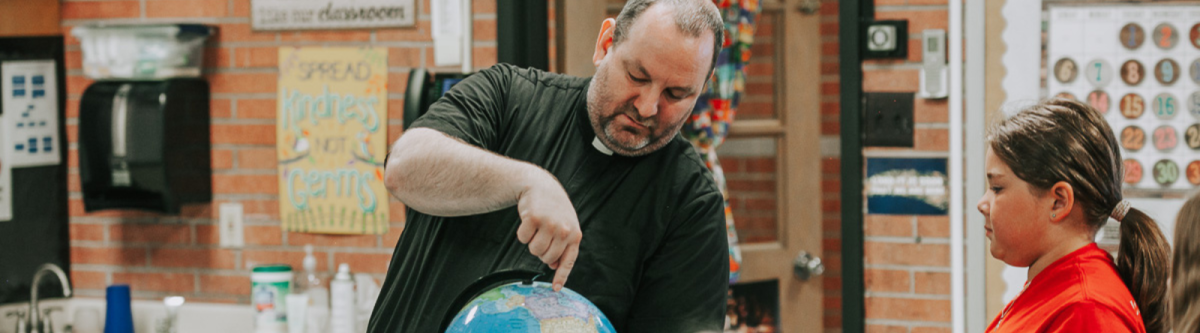
We believe elementary school should spark curiosity, build confidence, and set the stage for lifelong success. That’s why we use trusted, research-based programs across all subjects—programs designed to meet every child where they are and help them grow.
Here’s what your child will learn in each subject, and the value it brings.
Math — McGraw Hill (Core) + IXL (Personalized Practice)
What students learn (K–5): numbers and operations, place value, addition and subtraction fluency, fractions, multiplication & division strategies, geometry, measurement, and early algebraic thinking.
How we teach it:
- McGraw Hill introduces math through hands-on activities, problem-solving, and clear visuals that help students understand the “why” behind math.
- IXL gives every student a personalized pathway with skill practice matched exactly to their level, plus real-time diagnostics that guide growth.
Why it’s valuable: your child gets both a strong foundation and targeted support—building confidence, accuracy, and the ability to tackle more complex math later on.
More information:
www.mheducation.com/prek-12
www.ixl.com/math
Science — SAVVAS
What students learn (K–5): life science (plants, animals, ecosystems), earth science (weather, landforms, space), physical science (motion, energy, matter), and early engineering/design thinking.
How we teach it: lessons begin with real-world phenomena (“Why do shadows change during the day?”) and guide students through hands-on investigations, experiments, and problem-solving.
Why it’s valuable: children don’t just memorize facts—they act like scientists, asking questions, testing ideas, and connecting science to their everyday world.
More information: www.savvas.com/solutions/science
Social Studies — Studies Weekly
What students learn (K–5): community and citizenship, geography and maps, state and U.S. history, government, economics, and cultural diversity.
How we teach it: content is delivered in colorful, kid-friendly “weekly newspapers” and online explorations with interactive maps, primary sources, and engaging stories.
Why it’s valuable: students see themselves as part of a bigger story—learning civic responsibility, critical thinking, and respect for multiple perspectives.
More information: www.studiesweekly.com
English Language Arts — Success for All (SFA)
What students learn (K–5):
- K–2: phonics, decoding, spelling, vocabulary, listening, and comprehension.
- Grades 3–5: deeper comprehension strategies, writing for purpose, fluency, and discussion of rich texts.
How we teach it: structured daily reading blocks, cooperative learning, leveled group instruction, and tutoring where needed. Younger students start with Reading Roots (phonics-focused) while older students advance with Reading Wings (comprehension and vocabulary).
Why it’s valuable: every student gets what they need, whether that’s strong support in early literacy or enrichment through challenging books—ensuring all children become confident readers and writers.
More information: www.successforall.org/our-approach
Religion — (Sophia Institute)
What students learn (K–5): students explore big questions about life, values, and community through stories, reflection, and discussion. They learn principles of honesty, kindness, responsibility, empathy, and respect, guided by examples from history, literature, and Catholic faith traditions.
How we teach it: lessons combine storytelling, interactive activities, and reflection exercises that encourage students to think about choices, understand consequences, and practice virtues in everyday life.
Why it’s valuable: children build strong character, develop moral reasoning, and learn how to interact positively with others—skills that support both personal growth and academic success.
More information: www.sophiateachers.org/schools
The Big Picture: Why Families Love Our Curriculum
- Personalized learning: tools like IXL and SFA assessments ensure no child slips through the cracks.
- Engagement every day: hands-on science labs, interactive social studies, and math problem-solving make learning exciting.
- Skills that last: from reading fluency to critical thinking, students leave K–5 with the foundations they need for middle school and beyond.
- Character and values for life: students develop empathy, responsibility, respect, and ethical reasoning—skills that help them grow into thoughtful, caring, and confident individuals.